



Falls are discovered, not detected
A patient down in a corridor or waiting area is found by the next person to walk past — response time is pure chance.
Safer facilities without new cameras: fall detection in patient areas, restricted-zone enforcement for pharmacies and labs, hygiene compliance, and waiting-room flow — processed in-country, privacy-first.
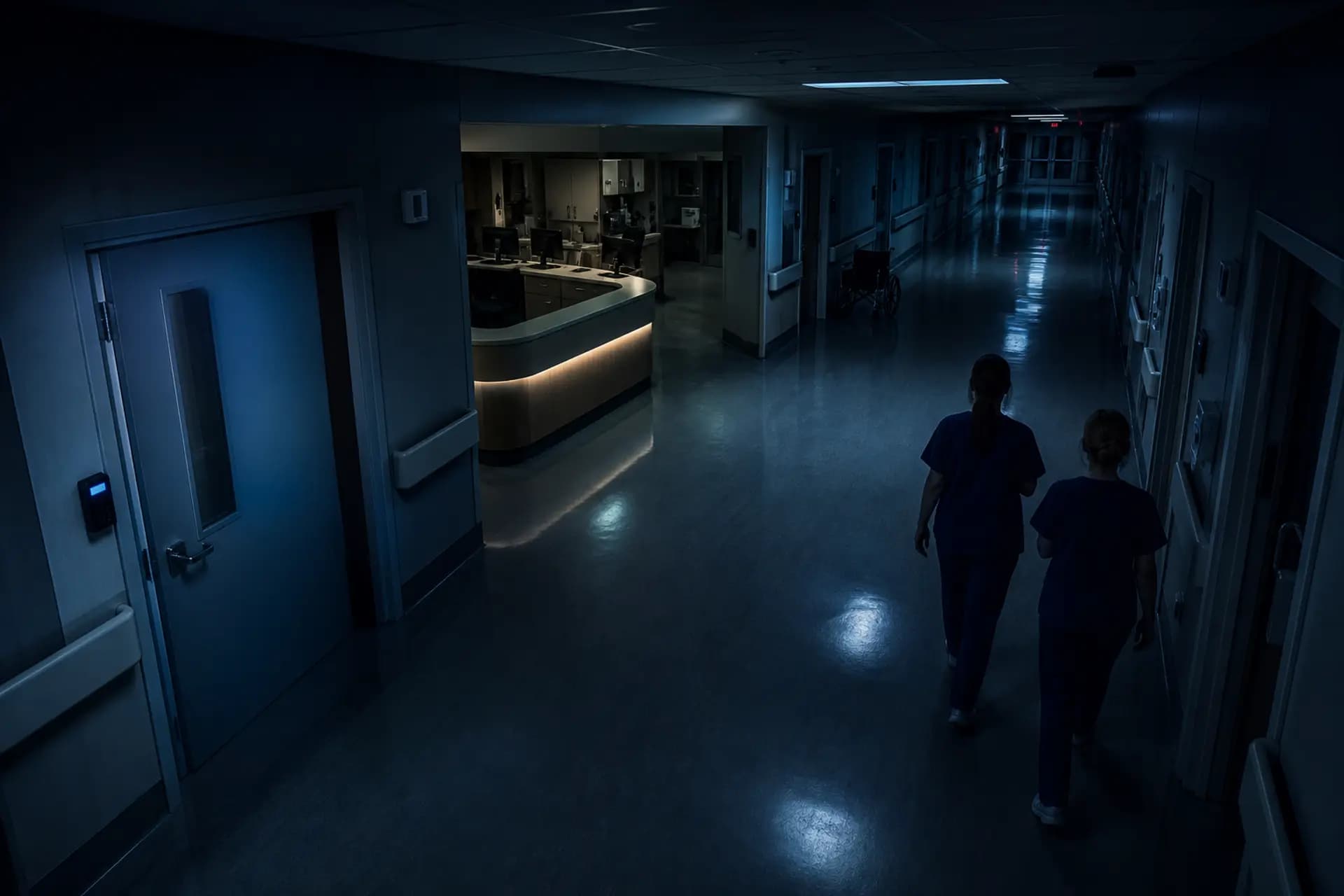
A patient down in a corridor or waiting area is found by the next person to walk past — response time is pure chance.
Badge logs say a door opened — not who went in, with whom, or what policy was breached.
Clinical environments need monitoring that is provably purpose-limited — generic CCTV analytics cannot demonstrate that.
Typical pilot targets agreed with healthcare teams before deployment — measured on your cameras, in your environment.
Every use case runs on the cameras you already own — deployed in days, governed by deterministic rules, and backed by sealed, audit-grade evidence.
Immediate alerts in corridors, wards, and waiting areas.
Pharmacies, labs, and medication rooms enforced beyond badge access.
Mask, glove, and gowning verification where policy requires it.
Queue and occupancy data for patient-flow decisions.
Perimeter and interior intrusion detection on existing CCTV.
Sealed, privacy-conscious records for reviews and claims.
Pick a use case and watch the rule that runs it — this is the entire configuration. No training data, no data-science team.
Healthcare · rule editor
CamEdge runs on-prem GPU inference against your current CCTV — no rip-and-replace, resilient to limited connectivity.
A deterministic rules engine enforces your policies — updated in minutes as operations change, with zero model retraining.
Every event lands in CamCore with an annotated clip and AI-written explanation — routed to your teams, ready for auditors.
In healthcare: Privacy-first by design: on-premises processing, no biometrics by default, and role-based access to any clip.
Camera AI in healthcare sits under real regulatory obligations across the GCC, ASEAN, and the EU. Camnitive is designed to satisfy them — with evidence, not assurances.
Regulation (EU) 2016/679
Processing stays on-premises, no biometrics by default, retention is policy-driven, and DPIA-ready documentation ships with the Conformity Pack.
EDPB Guidelines 3/2019
Every rule is scoped to a declared purpose, evidence access is role-based and audit-logged, and retention is enforced automatically.
Personal Data Protection Act 2012
Purpose-scoped rules and on-prem processing align with PDPC advisory guidelines; evidence access is logged end to end.
Personal Data Protection Law (SDAIA)
Sovereign deployment keeps processing and evidence inside the Kingdom; the KSA PDPL & Labour Regulation Pack scores residency and access controls continuously.
Directive (EU) 2022/2555
CamEdge runs on your network segment, air-gap ready, with no inbound cloud dependency — camera analytics without expanding your attack surface.
RA 10173 (2012)
Purpose-scoped analytics with logged, role-based evidence access and policy-driven retention.
Start with 10–50 of your existing cameras, prove value in weeks, and grow the same deployment into your operations system of record.
Prove fall detection, restricted-zone enforcement, and waiting-room analytics in one facility — privacy-first, processed in-country, on the cameras you already have.
Prefer to build the case yourself first? Four free self-serve tools:
A savings estimate seeded with healthcare defaults — tune it to your numbers.
Every rule we run in healthcare, with plain-English examples.
Draft camera policies and SOPs for your jurisdictions as a branded PDF.
Scope cameras, sites, use cases, and deployment model in minutes.
Answers to the questions healthcare teams ask most about deploying Camnitive — from camera requirements to compliance evidence.
Video is processed on-prem and never leaves your facility; there is no facial recognition or biometric identification — both are deliberately excluded from the platform. Detections are policy-based (a person has fallen, a zone was entered), and evidence access is role-controlled and audited.
Fall and man-down rules run continuously on existing cameras, alerting the nearest nursing station or security desk in seconds with an annotated frame — cutting response time in areas that patient-monitoring systems don't cover.
Yes. Camera-based zone rules verify what actually happens at the door — tailgating, propped doors, out-of-hours entry — and seal every exception with time-stamped evidence for pharmacy and compliance review.
The architecture is built for it: on-prem inference, in-country data residency, and privacy-first analytics support health-sector obligations under GDPR, the Saudi and UAE PDPL, and ASEAN privacy laws.
Yes. Waiting-room occupancy and queue analytics run anonymously on the same cameras, giving operations teams live data for staffing and flow decisions — no new sensors, no privacy trade-off.
Fall detection in high-traffic corridors and waiting areas, restricted zones on pharmacies and labs, and after-hours security — then hygiene compliance and flow analytics on the same deployment.
Occupancy, security, and service quality in the buildings people move through.
On the cameras you already own. Start with a 10–50 camera pilot, see measurable ROI in weeks, and grow it into your operations system of record.